Blackwork tattoo ideas
Blackwork builds an image with black ink and the spaces left between it. Solid shapes, cutout details and strong contrasts often matter more than subtle tonal modeling. Subjects with a recognizable silhouette can work as starting points for this graphic approach.
Create in this stylePlan the composition
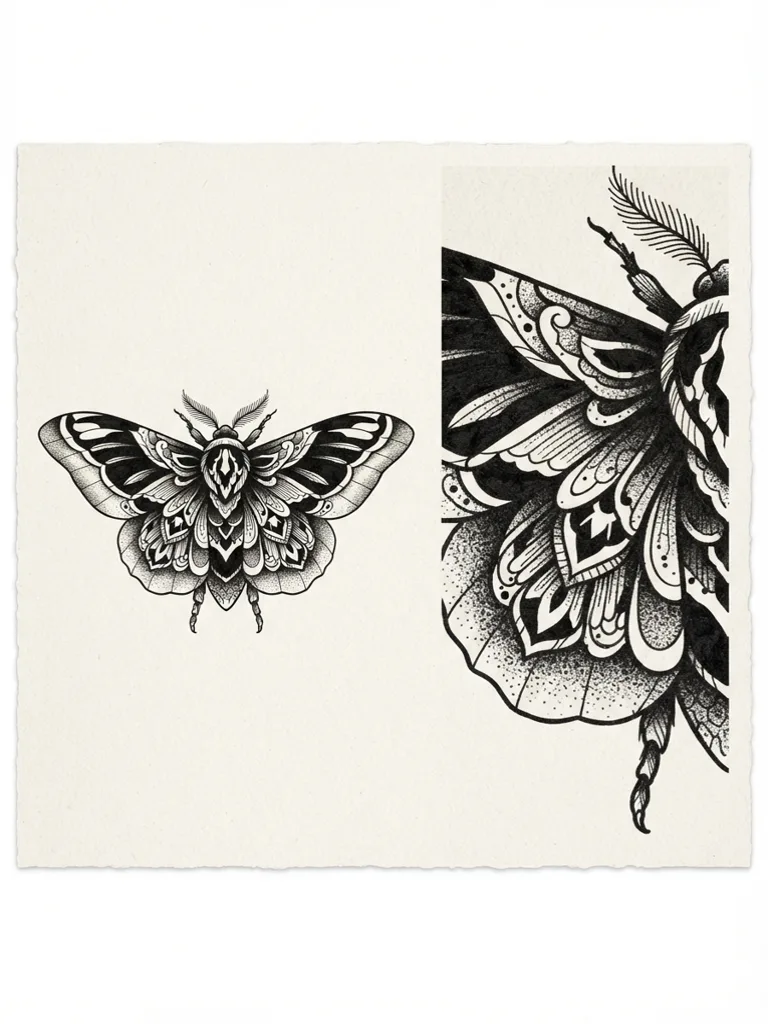
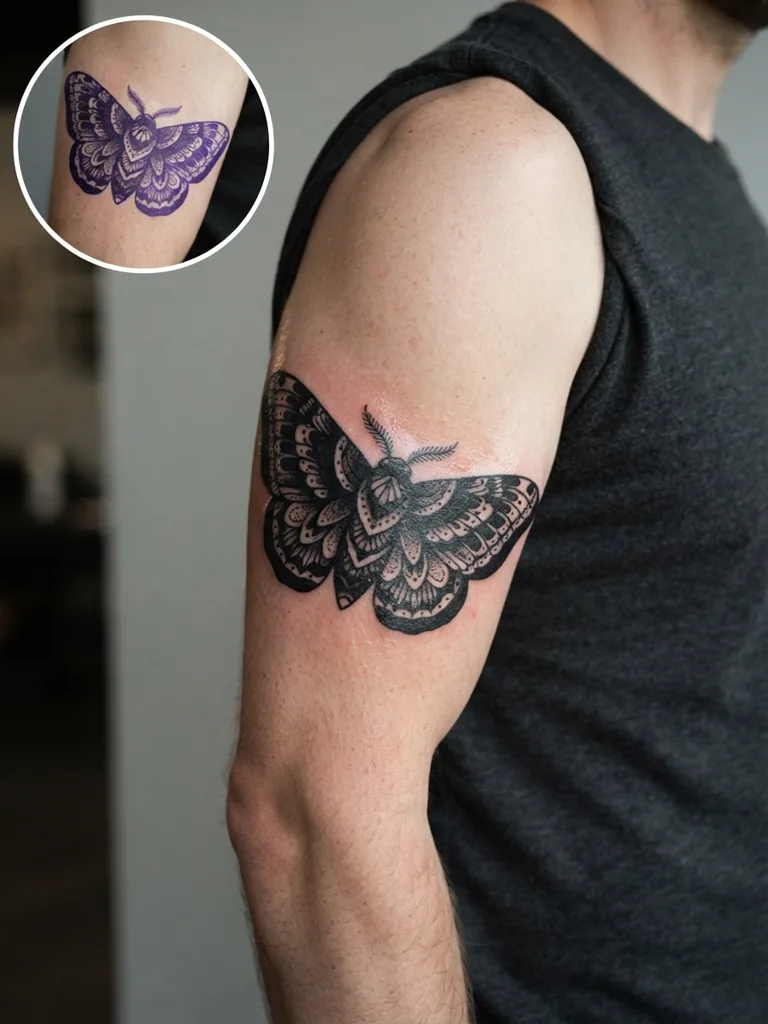
Describe both the dark areas and the gaps you want to retain. A moth, for example, can have solid outer wings with open bands through the center. Avoid asking for every surface to be filled; negative space gives the subject separation and helps the composition stay legible.
A prompt to start from
A front-facing moth with broad symmetrical wings, blackwork tattoo concept, solid black outer shapes and open crescent bands, clear antennae, no grey wash or color, isolated on white.Try this prompt
More prompts to adapt
A crescent moon overlapping a solid circle, blackwork tattoo concept, two shapes only, a clean bare band where they overlap, hard edges, no texture or grey wash, centred on white.Try this prompt
A pine forest silhouette along a straight horizon, blackwork tattoo concept, solid black trees of varied height, bare skin left between trunks, no sky detail, horizontal composition on white.Try this prompt
What drives the time and cost
Solid black is slow to lay down evenly, and the time scales with filled area rather than outline length. Larger pieces are often planned across more than one sitting. Ask whether the fill is meant to be finished in one session or two, and whether a second pass over the black is included in what you were quoted.
Prices depend on the artist, the city and the piece, so none are quoted here. This is about what makes this style quick or slow, so you can read a quote instead of guessing at one.
How to read a portfolio for this style
Only healed photographs tell you anything about a solid fill. Look for even, uninterrupted black with no patchiness, and look hard at the boundary between the black and the bare skin: it should be a clean edge, not a ragged one.
Placement and scale
Blackwork reads from across a room, which is what it is for. That also sets a floor. Shrink a design and the open bands separating the solid shapes close up, turning a silhouette into a blob. Outer arm, thigh, calf and back give the flat, uninterrupted area these shapes want. If you need something small, take elements out of the design rather than scaling the whole thing down.
How it ages
The outline of a solid shape holds its read for a long time. What moves is its edge, and the gaps you left inside it. A band of bare skin that looks generous on screen is the first thing to narrow, so draw it wider than it appears to need. Large flat fills are a separate craft question: how evenly they take, and whether they will want attention later, is a conversation for your artist rather than something an image can settle.
What follows is about how a drawing is built, not about healing or aftercare. How your skin takes and keeps ink is a question for the artist who will do the work.
Questions before you create
Blackwork or black and grey?
Blackwork builds an image from solid ink and bare skin, with no middle tone. Black and grey builds it from a range of greys, so a form can turn and recede. If your subject is recognisable as a silhouette, blackwork suits it. If it depends on volume, like a face or draped fabric, grey does work that solid black cannot.
Can a blackwork concept automatically serve as a cover-up?
No. Dark areas in a concept do not show whether an existing tattoo can be covered. A cover-up depends on the existing work, placement and an artist's assessment. Treat the generated image as a stylistic reference, not a cover-up plan.
Can I take the generated image straight to a tattoo appointment?
Use it as a conversation reference. An artist needs to review the drawing, adapt it to your body and intended size, and decide how to translate its lines and shading into tattoo work. A generated image is not a guarantee of a workable stencil or healed result.
Does opening the generator start a paid generation?
No. The link selects this style, and the prompt link also fills in the example text. You can edit both before choosing Generate. The generator shows the selected model and credit cost; normal sign-in and credit requirements still apply.
AI Tattoo produces design concepts, not tattoo-ready instructions. Review line spacing, placement, scale and practical execution with a tattoo artist before committing to a design.