Ornamental tattoo ideas
Ornamental designs put decoration and flow at the center of the image. Repeating curves, pointed forms and pendant-like shapes can frame an area without depicting a specific object. The relationship between a central motif and its surrounding space is often the main design decision.
Create in this stylePlan the composition
Choose a central axis and a direction for the pattern to taper. Use fewer repeating units with enough space between them rather than a dense lace-like mesh. If a design borrows from a named cultural tradition, investigate its context rather than using a generic ornament label as an explanation.
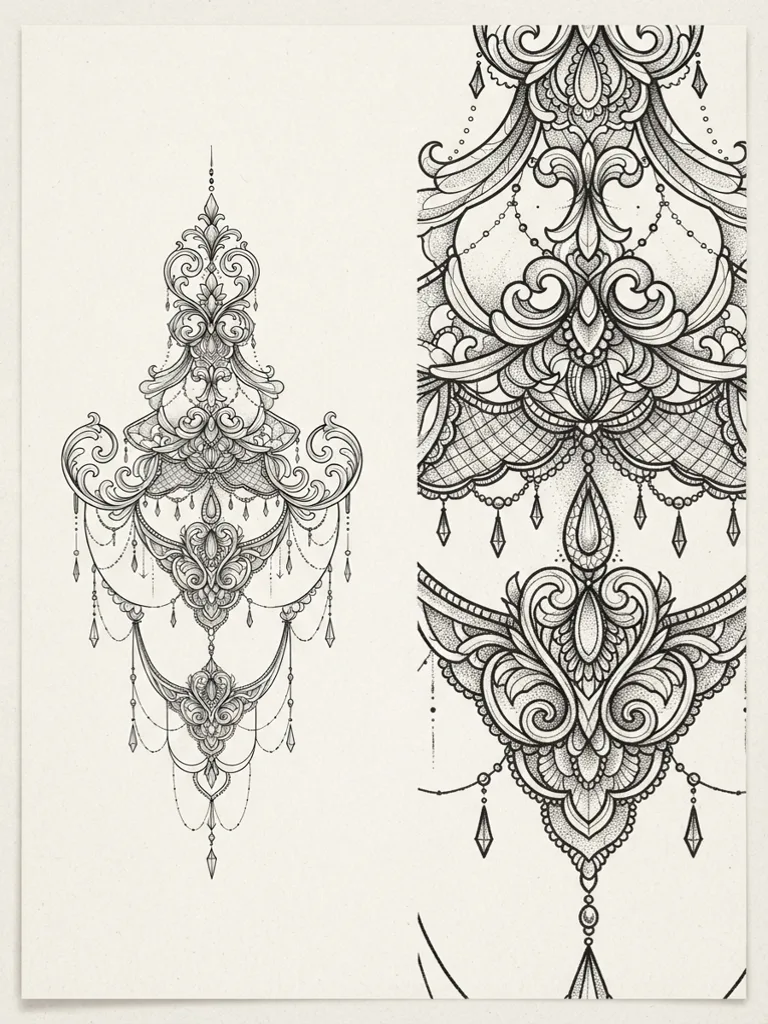
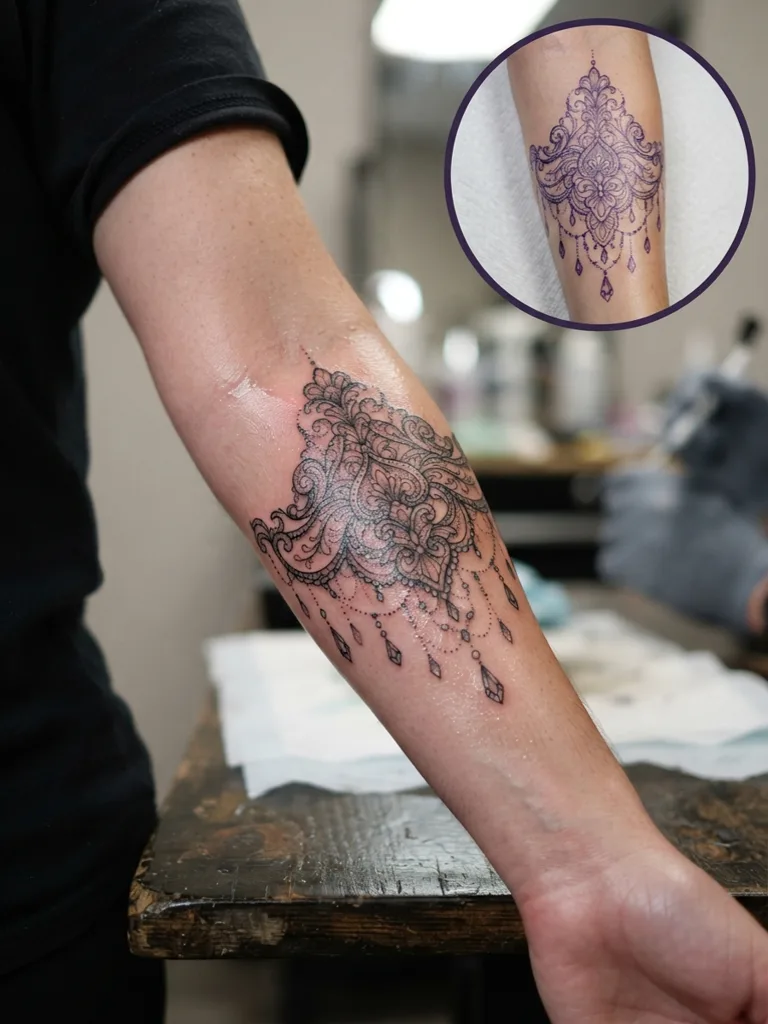
A prompt to start from
A pendant-inspired ornamental tattoo concept, one central teardrop with mirrored curved flourishes, three tapered hanging points, fine black outlines and selective solid accents, clear open gaps, vertical composition on white, no religious symbols.Try this prompt
More prompts to adapt
A symmetrical lotus mandala, ornamental tattoo concept, repeating petal rings, fine internal linework, perfect bilateral symmetry, bare space at the centre, square composition on white, no text.Try this prompt
A vertical filigree band of repeating teardrop motifs, ornamental tattoo concept, symmetrical about its long axis, fine scrollwork between motifs, open skin left along the outer edges, vertical composition on white, no text.Try this prompt
What drives the time and cost
Symmetry costs time before the needle starts. Fitting a repeating pattern to the curve of a limb so that it still reads as symmetrical is stencil work, and it is normal for that to take a sizeable part of the appointment. A quote that seems high for the amount of ink may be accounting for exactly that.
Prices depend on the artist, the city and the piece, so none are quoted here. This is about what makes this style quick or slow, so you can read a quote instead of guessing at one.
How to read a portfolio for this style
Check symmetry in a healed photograph taken straight on rather than at an angle, since an angled shot hides a great deal. Then look at how a pattern turns a corner or wraps a limb. That is where an artist either solved the geometry or quietly fudged it, and it is the part you will see every day.
Placement and scale
Ornamental work is placed before it is drawn. A pattern is built to sit on a specific part of the body, following the line of a collarbone, a spine, the back of an arm, and the same pattern moved elsewhere stops working. Decide the placement first and let the design be made for it. Symmetry is read against your own body, so a piece centred on the spine has to be centred on your spine, not on the drawing.
How it ages
Repetition is forgiving and fine detail is not. The overall rhythm of an ornamental piece survives well, because the eye reads the pattern rather than any single element. What fades from the design is the smallest internal work: the thin line inside a petal, the dot in the centre of a motif. Ask whether the pattern still reads once the finest layer is gone, because that is the version you will have longest.
What follows is about how a drawing is built, not about healing or aftercare. How your skin takes and keeps ink is a question for the artist who will do the work.
Questions before you create
Ornamental or geometric?
Ornamental decorates a part of the body and usually draws on an existing decorative tradition, so it answers to taste and to that tradition. Geometric is construction for its own sake, judged on precision. If what you like is how a pattern follows the body, ask for ornamental. If what you like is exactness, ask for geometric and expect to be judged on the lines.
Should ornamental designs always be perfectly symmetrical?
No. Symmetry is one possible organizing choice. An asymmetric design can follow a different direction or frame a subject. State your preference in the prompt and discuss the placement with your artist; a flat symmetrical image will not map unchanged onto every body area.
Can I take the generated image straight to a tattoo appointment?
Use it as a conversation reference. An artist needs to review the drawing, adapt it to your body and intended size, and decide how to translate its lines and shading into tattoo work. A generated image is not a guarantee of a workable stencil or healed result.
Does opening the generator start a paid generation?
No. The link selects this style, and the prompt link also fills in the example text. You can edit both before choosing Generate. The generator shows the selected model and credit cost; normal sign-in and credit requirements still apply.
AI Tattoo produces design concepts, not tattoo-ready instructions. Review line spacing, placement, scale and practical execution with a tattoo artist before committing to a design.