Japanese-inspired tattoo ideas
Japanese-inspired concepts use directional movement and relationships between the main subject and surrounding shapes. A koi, flower or wave should feel part of a composition rather than a collection of unrelated symbols. These guides offer visual starting points, not a substitute for cultural or artistic expertise.
Create in this stylePlan the composition
Specify the direction of movement and leave breathing room around the main subject. For a sleeve or larger piece, discuss the whole placement with an artist before combining separate images. Ask about motif combinations and meanings rather than assuming an AI-generated pairing is appropriate.
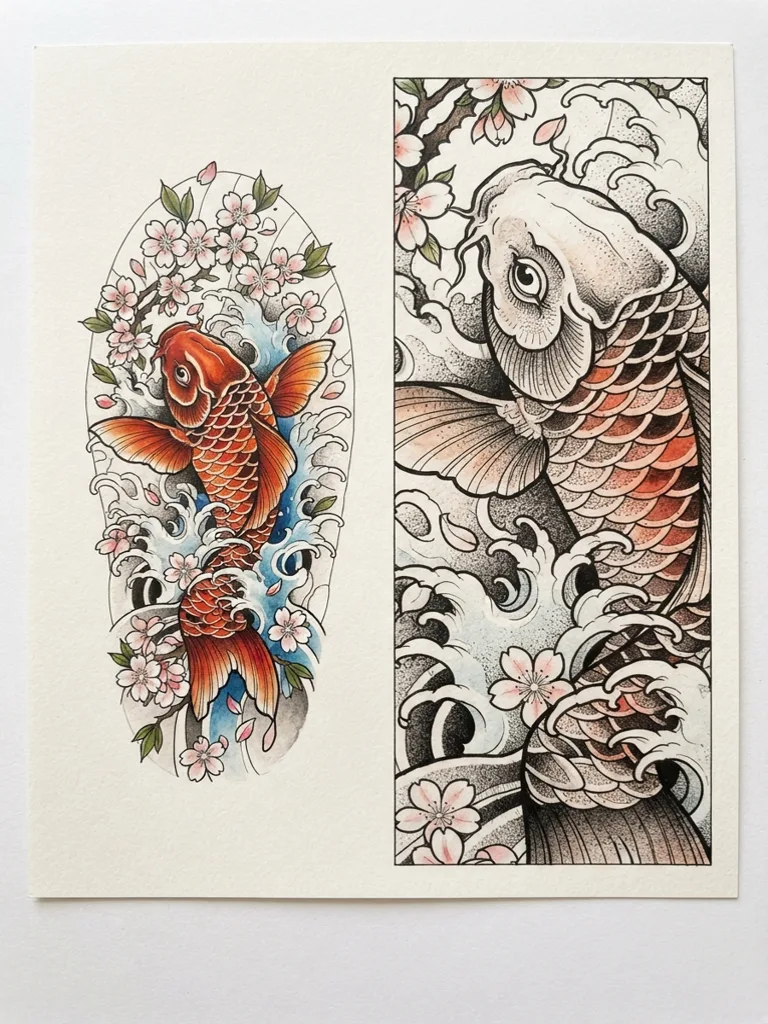
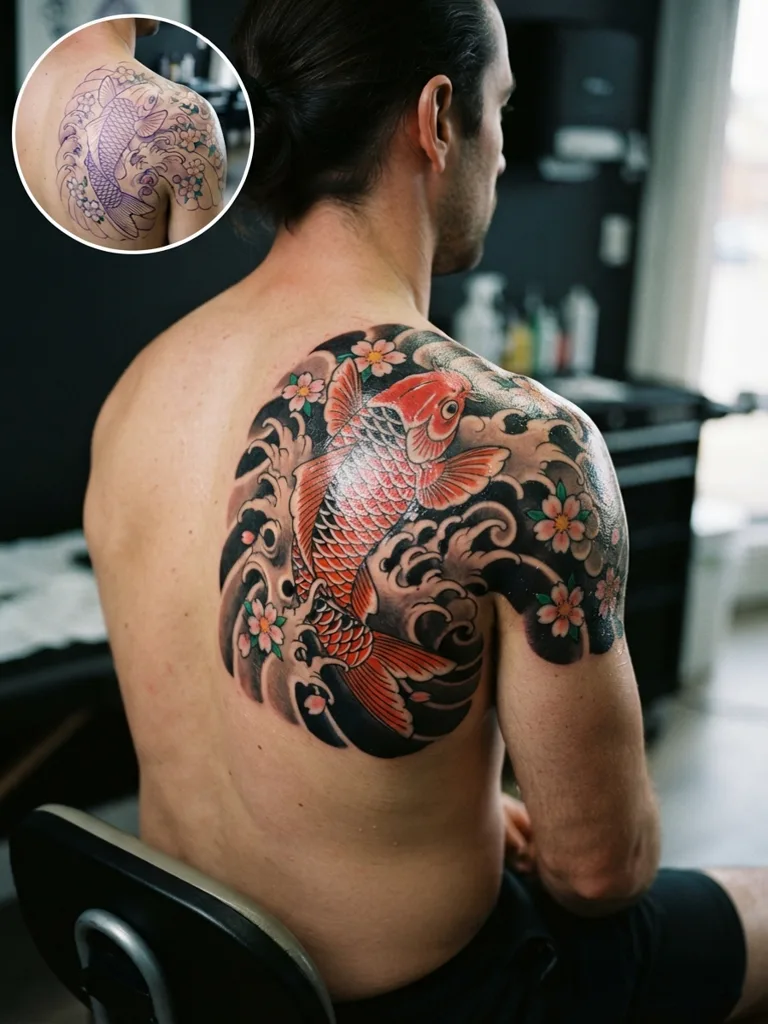
A prompt to start from
One koi curving upward through two flowing wave bands, Japanese-inspired tattoo concept, bold contours, restrained red and black areas, clear separation between fish and water, vertical composition on white, no text or extra symbols.Try this prompt
More prompts to adapt
A single koi swimming upward against stylised water, Japanese tattoo concept, bold black outline, scales as repeated curved shapes, water as parallel carved lines, vertical composition on white, no text.Try this prompt
A peony flower with two leaves and a wind bar behind it, Japanese tattoo concept, heavy outline, layered petals, background lines running diagonally behind the bloom, square composition on white, no text.Try this prompt
What drives the time and cost
Priced as a project rather than a piece. Large Japanese work is normally planned across sessions over months, and the background is the long part, not the subject. Ask how the whole thing is sequenced before the first session, because that first outline commits you to the rest of the plan.
Prices depend on the artist, the city and the piece, so none are quoted here. This is about what makes this style quick or slow, so you can read a quote instead of guessing at one.
How to read a portfolio for this style
Look for whole compositions, not details. This style lives on how the subject, the wind bars and the background flow together across a body part. An artist with excellent dragons but no large healed pieces may never have had to solve that planning problem.
Placement and scale
This style assumes the body, not a rectangle. A sleeve, a back piece or a thigh panel is the unit it was built for, and the composition is planned to follow the limb so that the subject reads from the angle people actually see you from. A small Japanese piece is possible but it is a different thing: you are buying the motif without the flow that the style is actually about.
How it ages
The background is what protects the foreground. Wind bars, water and cloud are not filler; they hold the composition together as the lines inside the subject soften, which is why old Japanese work still reads as a dragon rather than as a tangle. If budget forces a choice between finishing the subject and finishing the background, that is worth discussing as a question about the next twenty years, not this appointment.
What follows is about how a drawing is built, not about healing or aftercare. How your skin takes and keeps ink is a question for the artist who will do the work.
Questions before you create
Japanese or neo-traditional?
Japanese carries a set of established motifs and rules about how they combine, which season goes with which creature, which direction the water runs. Neo-traditional borrows boldness and colour but answers to no such system. If the meaning of the combination matters to you, ask for Japanese and find an artist who can explain the pairings. If you want the look without the grammar, neo-traditional is the more honest request.
Does an AI-generated motif have an authoritative meaning?
No. An image generator can combine motifs without understanding their context. If symbolism matters to you, research the specific subject and consult an artist familiar with the tradition. Do not treat a generated composition as an authenticated traditional design.
Can I take the generated image straight to a tattoo appointment?
Use it as a conversation reference. An artist needs to review the drawing, adapt it to your body and intended size, and decide how to translate its lines and shading into tattoo work. A generated image is not a guarantee of a workable stencil or healed result.
Does opening the generator start a paid generation?
No. The link selects this style, and the prompt link also fills in the example text. You can edit both before choosing Generate. The generator shows the selected model and credit cost; normal sign-in and credit requirements still apply.
AI Tattoo produces design concepts, not tattoo-ready instructions. Review line spacing, placement, scale and practical execution with a tattoo artist before committing to a design.