American traditional tattoo ideas
American traditional designs emphasize strong outlines, simplified forms and a limited palette. A subject is usually readable without intricate surface detail. Swallows, roses and nautical objects offer starting points, but you can also apply this visual approach to a personal subject.
Create in this stylePlan the composition
Choose a compact silhouette and a small group of colors rather than elaborate lighting effects. Name the main subject and remove decorative additions that compete with it. If lettering is important, treat its wording and readability as a separate review step with your artist.
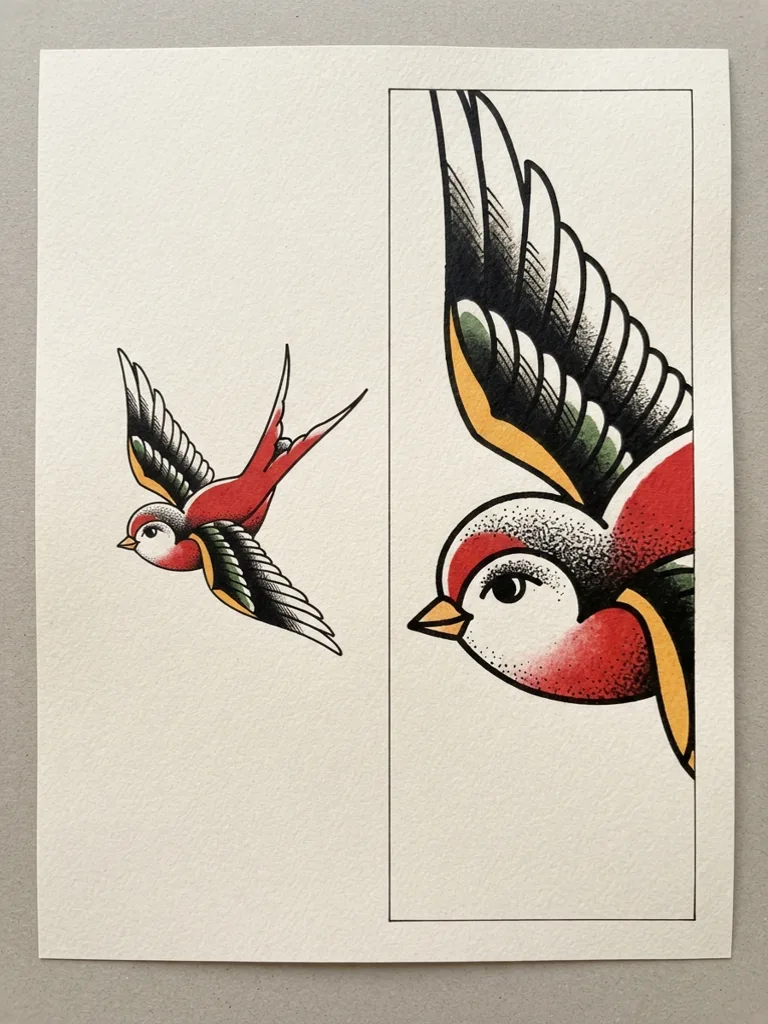
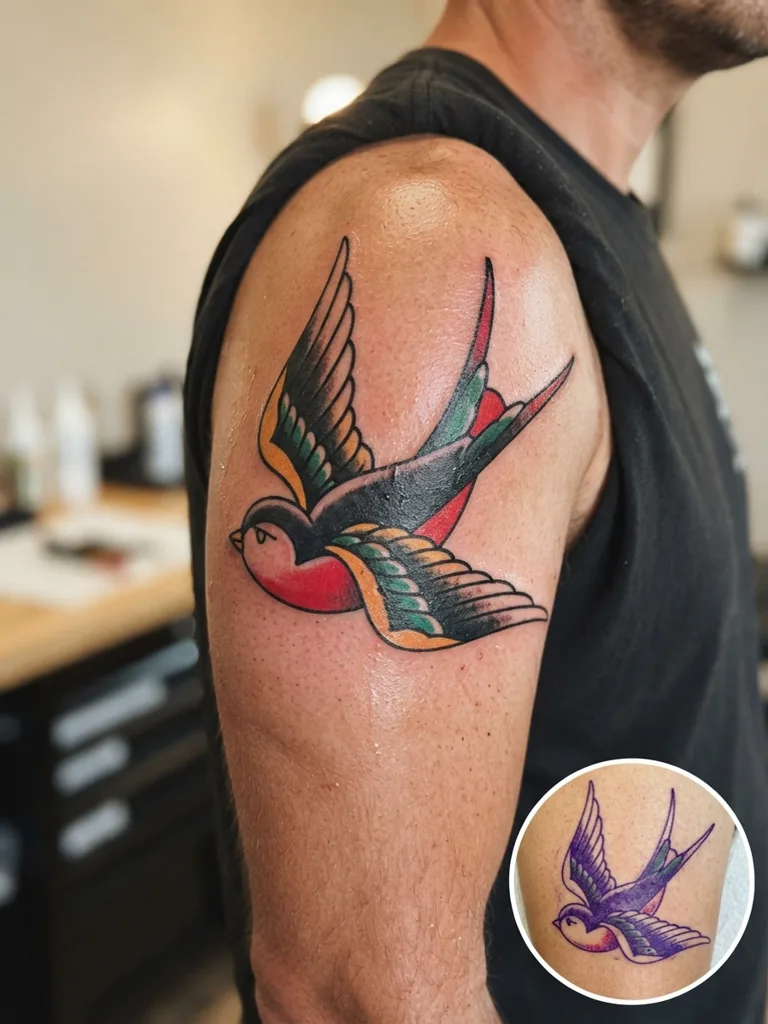
A prompt to start from
A swallow in flight carrying a small leaf, American traditional tattoo concept, bold black outlines, simple feather groups, limited red gold and muted green accents, compact balanced silhouette, white background, no lettering.Try this prompt
More prompts to adapt
A clipper ship on three stylised waves, American traditional tattoo concept, bold even outlines, sails in flat cream and muted red, wave crests as simple repeated curls, compact silhouette on white, no lettering.Try this prompt
A closed rose with four leaves, American traditional tattoo concept, heavy outline, petals simplified into clear stacked shapes, red and deep green only, small black shadow under each leaf, white background, no lettering.Try this prompt
What drives the time and cost
Among the quickest styles for its size, which is part of why it exists. The outline goes in once, flat colour fills it, and there is little blending to build up. A compact traditional piece is often a single sitting. If lettering is involved, add proofreading time to the conversation, not just tattooing time.
Prices depend on the artist, the city and the piece, so none are quoted here. This is about what makes this style quick or slow, so you can read a quote instead of guessing at one.
How to read a portfolio for this style
The test is whether the outline still contains the colour in healed work. Look for a black line that has stayed crisp and colour that has not crept past it. An artist with plenty of fresh photographs and no healed ones has not shown you the thing this style is judged on.
Placement and scale
The style was drawn for limbs. A compact silhouette sits on the curve of an arm or a calf without distorting, and the bold outline keeps it readable at the size a limb allows. It is also why traditional pieces tile well: each one is a closed shape, so several can sit near each other without merging. Give your artist the placement first. A design adapts to the space far more easily than the reverse.
How it ages
This style is in part an answer to ageing. The heavy outline, the simplified forms and the short palette were not decorative choices. They were what stayed readable on working people for decades before anyone wrote the rules down. The outline holds the shape while the colour inside it softens, so the drawing still reads long after comparable detail would have gone from a finer piece. How individual inks behave is your artist's territory, and worth asking about if colour matters to you.
What follows is about how a drawing is built, not about healing or aftercare. How your skin takes and keeps ink is a question for the artist who will do the work.
Questions before you create
Traditional or neo-traditional?
Traditional keeps the outline at one weight and the palette short, and simplifies the form until it reads at a glance. Neo-traditional keeps the bold outline but varies its weight, adds ornament around the subject and layers more colour into it. Ask for traditional when you want the drawing quiet and durable. Ask for neo-traditional when you want the subject to carry decoration.
How does traditional differ from neo-traditional?
For prompt writing, traditional usually means simpler forms, a tighter palette and bold consistent outlines. Neo-traditional leaves more room for varied line weights, ornament and layered color. These are useful directions, not rigid rules that every artist follows.
Can I take the generated image straight to a tattoo appointment?
Use it as a conversation reference. An artist needs to review the drawing, adapt it to your body and intended size, and decide how to translate its lines and shading into tattoo work. A generated image is not a guarantee of a workable stencil or healed result.
Does opening the generator start a paid generation?
No. The link selects this style, and the prompt link also fills in the example text. You can edit both before choosing Generate. The generator shows the selected model and credit cost; normal sign-in and credit requirements still apply.
AI Tattoo produces design concepts, not tattoo-ready instructions. Review line spacing, placement, scale and practical execution with a tattoo artist before committing to a design.