Black and grey tattoo ideas
Black and grey uses tonal changes rather than colored ink to separate forms. It can describe soft petals, sculptural objects or illustrative subjects. Unlike solid blackwork, the transition between light and dark is an important part of how the image reads.
Create in this stylePlan the composition
Give the design one light direction and a clear focal area. Keep the lightest parts open instead of filling every surface with grey. If a subject has many overlapping parts, ask for separation between them so that the image does not become a uniform shaded mass.
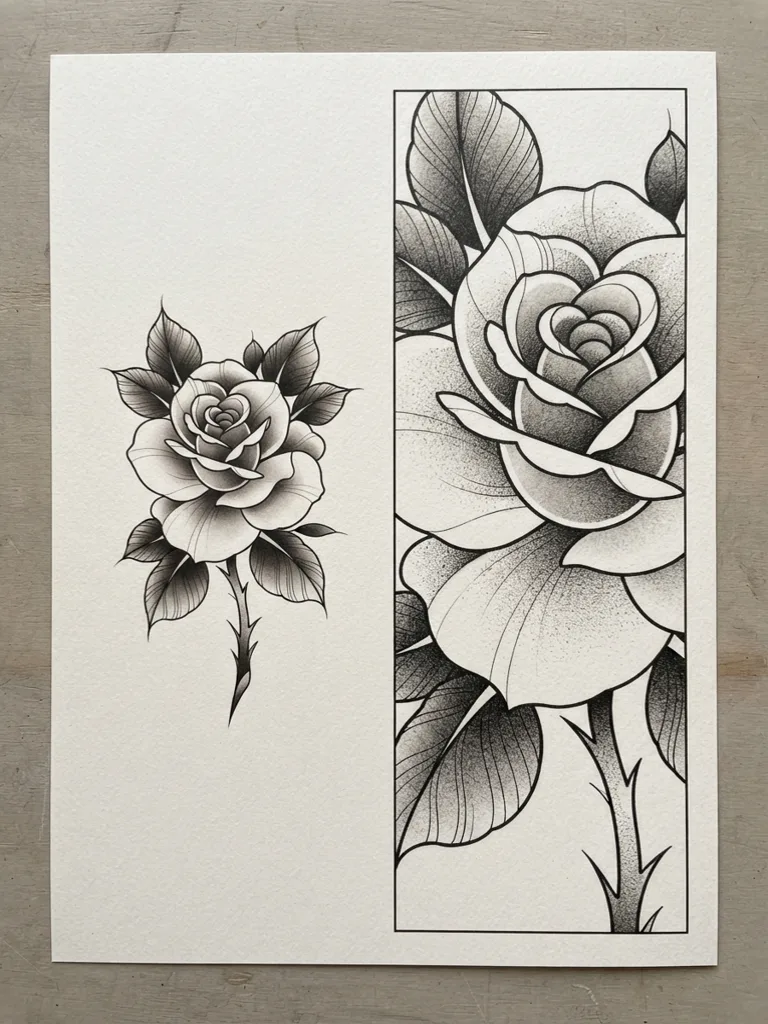
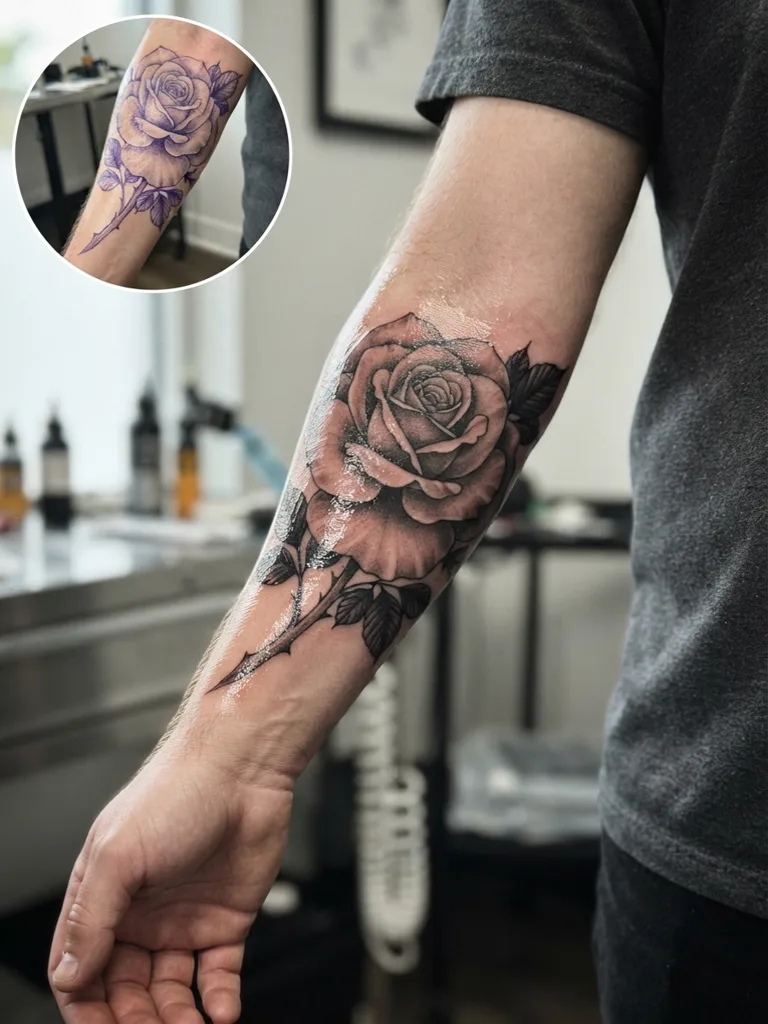
A prompt to start from
A single open rose viewed at a slight angle, black and grey tattoo concept, distinct overlapping petals, light from upper left, restrained grey shading and clear dark accents, no color, white background.Try this prompt
More prompts to adapt
A single feather seen from the side, black and grey tattoo concept, smooth tonal gradient along the shaft, bright highlight on one edge, no outline, soft falloff into white, vertical composition.Try this prompt
Two overlapping storm clouds, black and grey tattoo concept, deep shadow in the lower mass and open light at the upper edge, no black outline, wide tonal range, horizontal composition on white.Try this prompt
What drives the time and cost
Grey work is built in passes, and the smoothness you admire in a portfolio is the result of several. Time scales with how much of the piece is gradient, not with how large it is. A smooth, simple shoulder can take longer than a busy hand.
Prices depend on the artist, the city and the piece, so none are quoted here. This is about what makes this style quick or slow, so you can read a quote instead of guessing at one.
How to read a portfolio for this style
Look at healed mid-tones. Greys that were smooth when fresh can settle unevenly, and the giveaway is banding where a gradient should run continuous. Ask to see something more than two years old, which is when grey work either holds or does not.
Placement and scale
Grey needs room to turn. A gradient compressed into a small area becomes a flat smudge, because the steps between tones have nowhere to sit. Upper arm, thigh, chest and back give the span this style wants. If the space is small, ask for fewer tones rather than the same tones squeezed, which is a different drawing but a working one.
How it ages
Mid-tones are the part that moves. The darkest darks and the clean highlights tend to stay where they were put, while the greys between them drift closer together, so a piece gradually loses the middle of its range before it loses anything else. Contrast is what buys time. Ask your artist to keep the lightest areas genuinely light rather than lightly shaded.
What follows is about how a drawing is built, not about healing or aftercare. How your skin takes and keeps ink is a question for the artist who will do the work.
Questions before you create
Black and grey or realism?
They are not alternatives. Black and grey describes the palette; realism describes how closely the drawing follows what the eye would see. Plenty of black and grey work is not realistic at all, and realism can be done in colour. If you want a photographic likeness without colour, you are asking for both, and the artist you need is one who shows both.
Are all black and grey tattoos realistic?
No. Black and grey describes a tonal palette. It can be used for illustrative, ornamental or realistic imagery. If realism is your goal, also specify convincing proportions and light; if not, ask for simplified forms and deliberate outlines.
Can I take the generated image straight to a tattoo appointment?
Use it as a conversation reference. An artist needs to review the drawing, adapt it to your body and intended size, and decide how to translate its lines and shading into tattoo work. A generated image is not a guarantee of a workable stencil or healed result.
Does opening the generator start a paid generation?
No. The link selects this style, and the prompt link also fills in the example text. You can edit both before choosing Generate. The generator shows the selected model and credit cost; normal sign-in and credit requirements still apply.
AI Tattoo produces design concepts, not tattoo-ready instructions. Review line spacing, placement, scale and practical execution with a tattoo artist before committing to a design.