Fine line tattoo ideas
Fine line puts the contour first. Thin, deliberate strokes describe a subject without heavy outlines or large solid fills. Botanical stems, small objects and simple silhouettes are useful subjects because their defining features can be expressed with relatively few marks.
Create in this stylePlan the composition
Choose one focal subject and say which details matter. Ask for open gaps between leaves or overlapping shapes rather than a dense miniature drawing. A light-looking image can still contain too much detail for the intended size, so bring your artist a placement and scale reference.
A prompt to start from
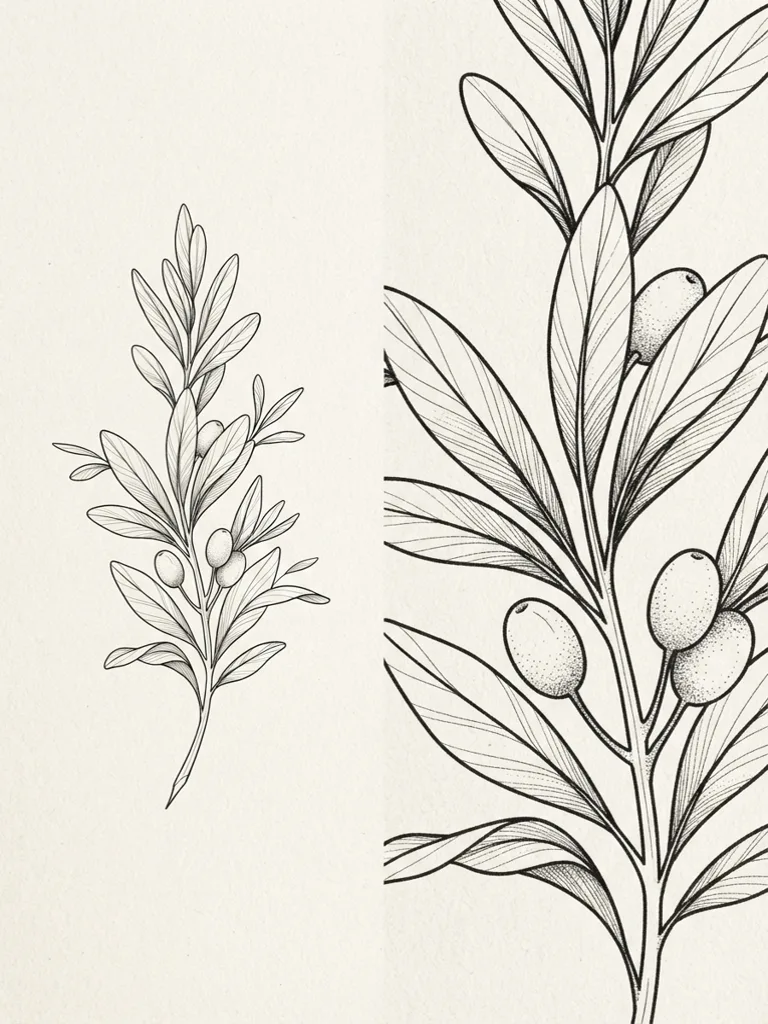
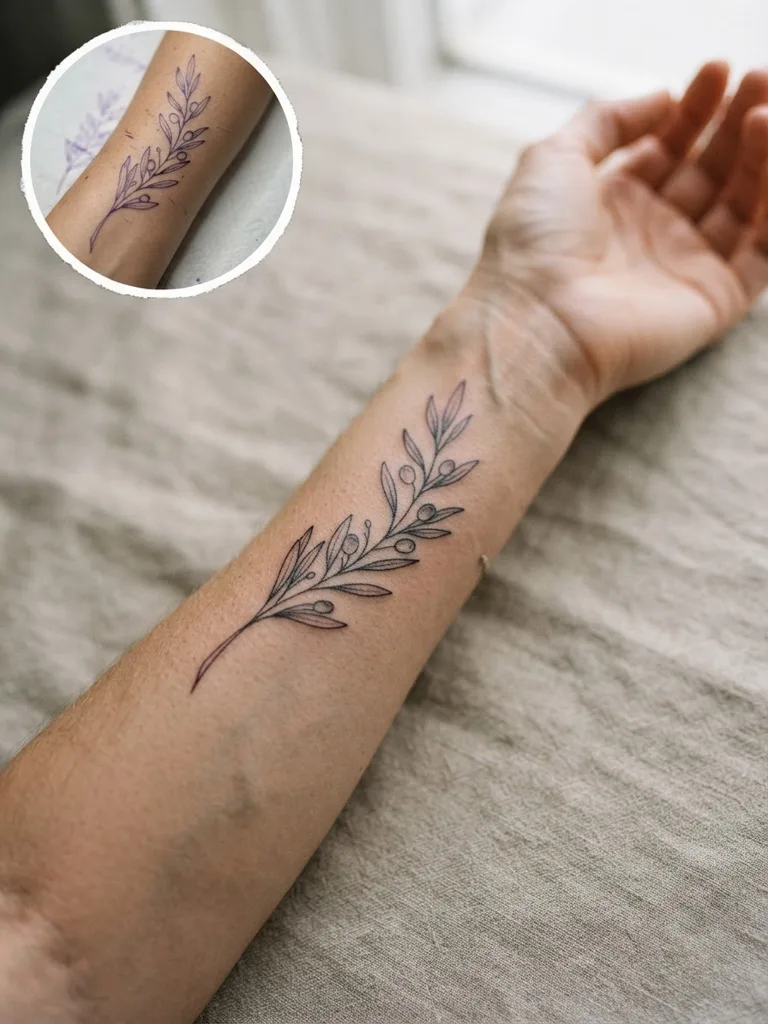
An olive branch with five spaced leaves, a gently curved stem and one small olive, fine line tattoo concept, precise black contours, minimal shading, generous open space, vertical composition on white, no text.Try this prompt
More prompts to adapt
A single swallow mid-flight seen from the side, fine line tattoo concept, continuous thin contour, no fill, wing feathers suggested by a few separated strokes, generous space between marks, horizontal composition on white, no text.Try this prompt
Three stems of wheat bound at the base, fine line tattoo concept, even hairline weight throughout, grains drawn as small open ovals, clear separation between each stem, vertical composition on white, no shading, no text.Try this prompt
What drives the time and cost
Small does not mean quick. A long single-pass line takes as much concentration as a large fill, and a stroke that wavers cannot be gone over again without thickening it. What moves the number is how many separate lines the drawing contains, not how big it is. Artists who do this work well often price by the piece rather than by the hour.
Prices depend on the artist, the city and the piece, so none are quoted here. This is about what makes this style quick or slow, so you can read a quote instead of guessing at one.
How to read a portfolio for this style
Ask for healed photographs, not fresh ones. Fresh fine line always looks crisp; what you want to know is how it looked a year later. Check whether thin strokes are still separate where they run close together, and whether a line holds an even weight from one end to the other.
Placement and scale
Scale is set by the smallest gap in the drawing, not by its overall size. Two lines a millimetre apart on screen will touch once the piece is shrunk. Forearms, upper arms and calves offer a flat enough surface to hold close detail. Hands, fingers and feet move and rub far more, so artists often ask for wider spacing or a simpler version in those places. Bring a placement and a measurement, not just the image.
How it ages
Ink spreads a little in the skin over the years, and a thin line carries less of it to begin with, so fine work changes shape sooner than heavy work does. What goes first is usually not the line but the space beside it: two strokes drawn close together start to read as one. Design for that now. Leave gaps that look slightly too generous, and ask your artist how this particular drawing will hold at the size and placement you want.
What follows is about how a drawing is built, not about healing or aftercare. How your skin takes and keeps ink is a question for the artist who will do the work.
Questions before you create
Fine line or minimalist: which should I ask for?
They answer different questions. Fine line describes how the marks are made; minimalist describes how many marks remain. Ask for fine line when you want delicate contours, even on a detailed subject. Ask for minimalist when you want fewer elements, whatever the line weight. Ask for both and you get a sparse drawing in thin strokes, which is the quietest of the four combinations.
Is fine line the same as minimalist?
No. Fine line describes the character of the lines; minimalist describes how much visual information remains. A detailed floral drawing can use fine lines without being minimalist. For a quieter result, request both fine contours and fewer elements.
Can I take the generated image straight to a tattoo appointment?
Use it as a conversation reference. An artist needs to review the drawing, adapt it to your body and intended size, and decide how to translate its lines and shading into tattoo work. A generated image is not a guarantee of a workable stencil or healed result.
Does opening the generator start a paid generation?
No. The link selects this style, and the prompt link also fills in the example text. You can edit both before choosing Generate. The generator shows the selected model and credit cost; normal sign-in and credit requirements still apply.
AI Tattoo produces design concepts, not tattoo-ready instructions. Review line spacing, placement, scale and practical execution with a tattoo artist before committing to a design.