Minimalist tattoo ideas
Minimalist designs reduce a subject to the parts needed to recognize it. The result might be a single outline, a compact symbol or a pair of balanced forms. The point is not simply to make the image small, but to decide what can be left out.
Create in this stylePlan the composition
Name the one feature that carries the idea: the curve of a mountain ridge, the bend of a stem or the shape of a familiar object. Limit secondary decoration and ask for a clear silhouette. Compare the design at your planned size rather than only as a large preview.
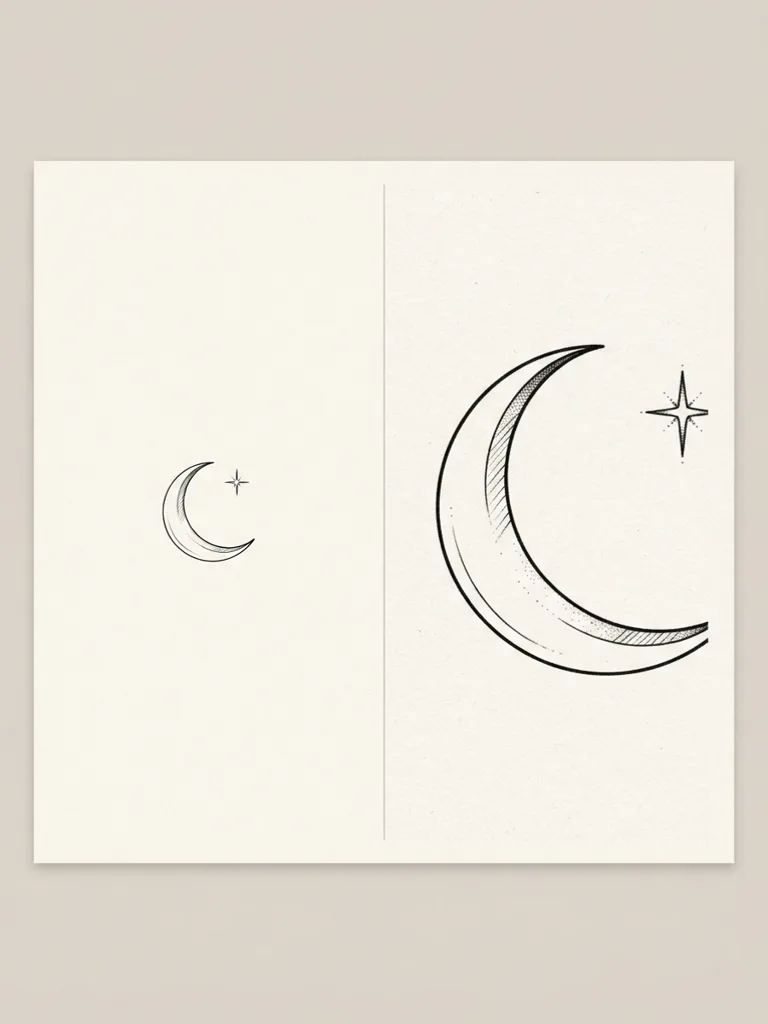
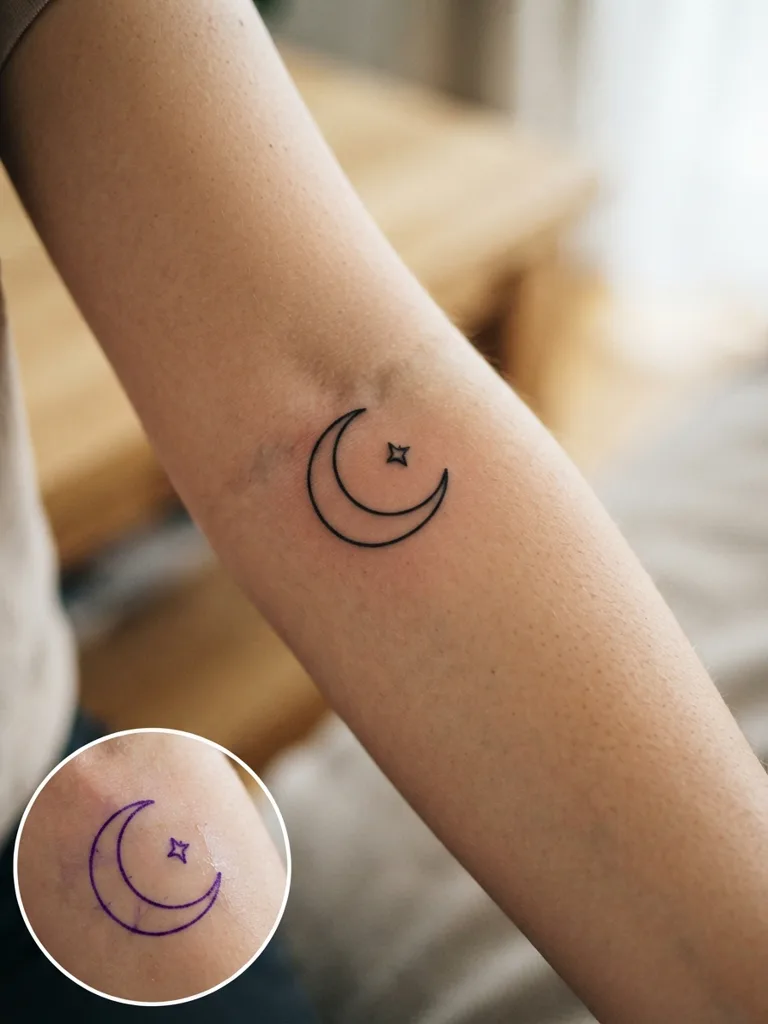
A prompt to start from
A single mountain ridge beneath a small open circle sun, minimalist tattoo concept, two distinct elements, clean black lines, no texture or landscape background, balanced horizontal composition on white.Try this prompt
More prompts to adapt
A single mountain range reduced to three overlapping triangles, minimalist tattoo concept, uniform line weight, no shading, no texture, wide empty margin, horizontal composition on white, no text.Try this prompt
One continuous line forming the profile of a face, minimalist tattoo concept, a single unbroken stroke, no lift and no fill, generous space around the shape, vertical composition on white, no text.Try this prompt
What drives the time and cost
Usually the shortest appointment on this list, which means the shop minimum, not the drawing, often sets what you pay. Every studio has a floor below which the price stops dropping. Ask what that floor is before you shrink a design to save money, because past a certain point you are paying the same for less tattoo.
Prices depend on the artist, the city and the piece, so none are quoted here. This is about what makes this style quick or slow, so you can read a quote instead of guessing at one.
How to read a portfolio for this style
With few marks on the skin, every one of them is visible. In healed work, look at the ends of strokes and at any small circles. An uneven stop or an out-of-round dot has nothing else in the design to distract from it.
Placement and scale
The design that survives being small is one that was drawn small. Wrist, ankle, behind the ear and the inside of a forearm all suit a few marks, and a minimal piece is one of the few that reads properly on a finger. What it cannot survive is being asked to carry detail later: there is no room to add to it without becoming a different drawing.
How it ages
Fewer marks means fewer things to go wrong, and minimalist work tends to hold its read longer than denser styles at the same size. The risk is concentrated instead: when a design is four lines, one line thickening is a quarter of the piece. Ask your artist which of the marks is the most fragile at the size you want, and whether moving it a few millimetres would help.
What follows is about how a drawing is built, not about healing or aftercare. How your skin takes and keeps ink is a question for the artist who will do the work.
Questions before you create
Minimalist or fine line?
Minimalist is about how much you leave out. Fine line is about how the remaining marks are drawn. A minimalist design can be rendered in a heavy outline and still be minimalist. If your reason for choosing it is that you want something small and quiet, you probably want both, and it is worth saying so rather than assuming one implies the other.
Does a minimalist tattoo need to be tiny?
No. Minimalism is about restraint, not dimensions. A larger design can still use very few elements. Start by simplifying the subject, then discuss the scale and spacing with your artist instead of forcing every idea into a tiny outline.
Can I take the generated image straight to a tattoo appointment?
Use it as a conversation reference. An artist needs to review the drawing, adapt it to your body and intended size, and decide how to translate its lines and shading into tattoo work. A generated image is not a guarantee of a workable stencil or healed result.
Does opening the generator start a paid generation?
No. The link selects this style, and the prompt link also fills in the example text. You can edit both before choosing Generate. The generator shows the selected model and credit cost; normal sign-in and credit requirements still apply.
AI Tattoo produces design concepts, not tattoo-ready instructions. Review line spacing, placement, scale and practical execution with a tattoo artist before committing to a design.