Realism tattoo ideas
Realism aims to describe believable form through proportion, lighting and texture. It asks different questions from a symbolic outline: where is the light, which plane faces the viewer, and which details make the subject recognizable? A clear reference is more useful than an overloaded description.
Create in this stylePlan the composition
Keep one focal plane sharp and simplify details outside it. Avoid turning the brief into a full photographic scene when the goal is an isolated tattoo concept. For a recognizable person or pet, review the result carefully; a convincing image is not necessarily an accurate likeness.
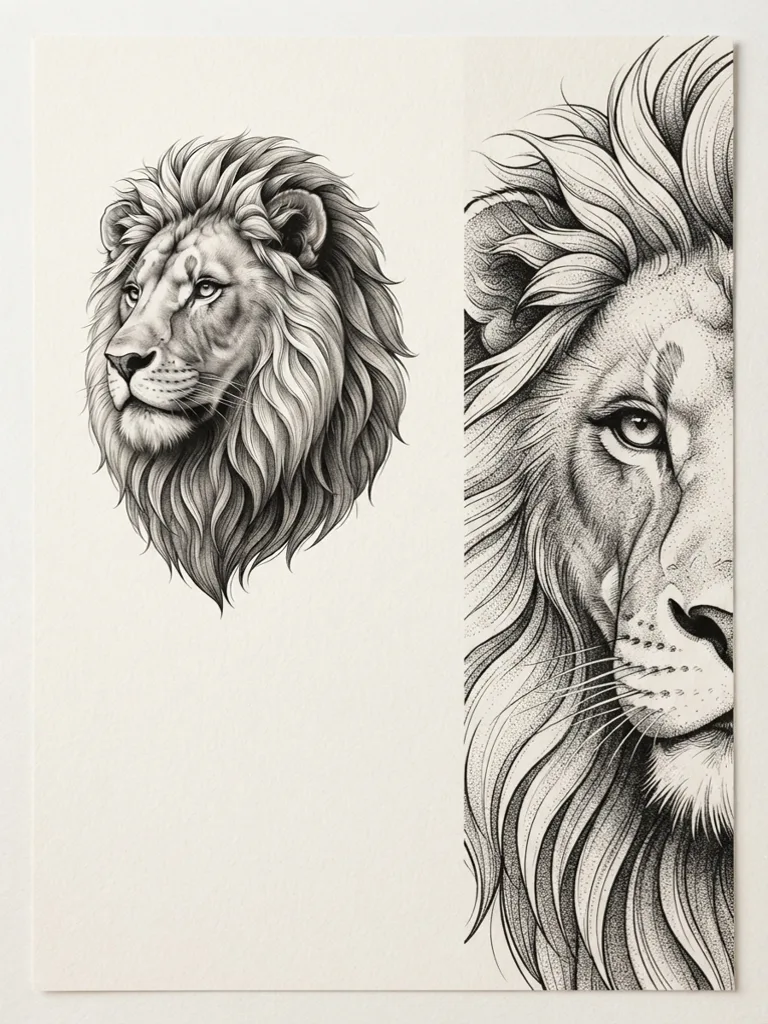
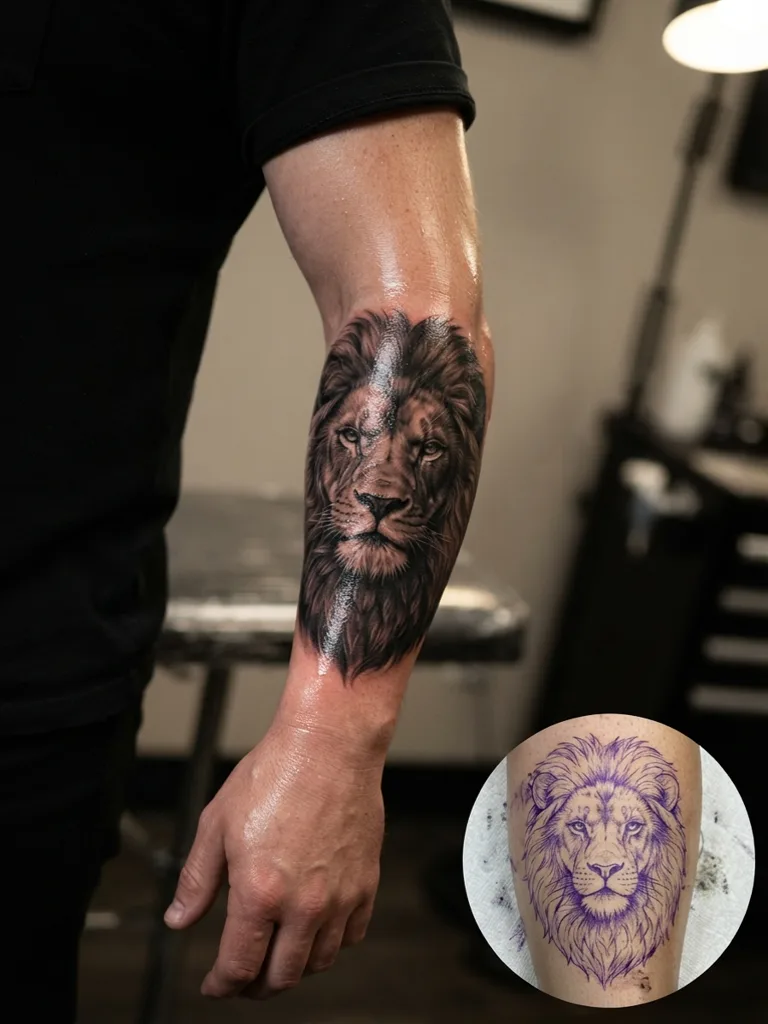
A prompt to start from
A raven head in three-quarter view, realism tattoo concept, believable beak proportions, focused eye detail, directional soft light and controlled black and grey feather shading, isolated on white, no scene or text.Try this prompt
More prompts to adapt
A wolf's head in three-quarter view, realistic tattoo concept, detailed fur direction, deep shadow under the jaw, bright catchlight in one eye, strong directional lighting, no outline, vertical composition on white.Try this prompt
A human eye with surrounding brow and lashes, realistic tattoo concept, sharp focus on the iris, soft gradient across the lid, defined highlight on the lower lash line, no outline, horizontal composition on white.Try this prompt
What drives the time and cost
The most session-hungry style here. Time goes into the places the eye checks first: eyes, mouth, the edge of a jaw. A portrait is normally several sittings, and the last one is often the longest because it is entirely refinement, which is the part that decides whether the piece works.
Prices depend on the artist, the city and the piece, so none are quoted here. This is about what makes this style quick or slow, so you can read a quote instead of guessing at one.
How to read a portfolio for this style
Look at healed work from across a room, because that is how a tattoo is actually seen. Realism that only holds together on a phone screen held close has not solved the problem. Look also for the same subject type as yours: portraits, animals and objects are different skills, and being good at one does not carry over.
Placement and scale
Realism needs size before anything else. A face has to be large enough for the eye to accept it as a face, and the usual floor is bigger than people expect: forearm, upper arm, thigh, calf, chest. A realistic portrait shrunk to palm size stops being a likeness and becomes a grey shape, which is the one failure this style cannot absorb.
How it ages
Fine detail is the first thing to go, and realism is made of fine detail. What survives is the large tonal structure: where the light is, where the shadow is, the shape of the mass. That is why experienced artists push the contrast further than the photograph does. Bring a reference with strong, simple lighting rather than a flat snapshot, because flat lighting gives the drawing nothing to hold onto later.
What follows is about how a drawing is built, not about healing or aftercare. How your skin takes and keeps ink is a question for the artist who will do the work.
Questions before you create
Realism or black and grey?
They answer different questions. Realism is about likeness; black and grey is about palette. You can have a realistic portrait in colour and an unrealistic drawing in grey. If you want a photographic result without colour, say both. If the person or animal matters more than the finish, say realism first and let the artist advise on colour.
Will realism generation preserve an exact likeness?
Not reliably. Generated features can drift even when a reference image is supplied. Compare proportions and identifying marks yourself, then ask an artist to redraw or correct the concept. Do not rely on the style setting as a likeness guarantee.
Can I take the generated image straight to a tattoo appointment?
Use it as a conversation reference. An artist needs to review the drawing, adapt it to your body and intended size, and decide how to translate its lines and shading into tattoo work. A generated image is not a guarantee of a workable stencil or healed result.
Does opening the generator start a paid generation?
No. The link selects this style, and the prompt link also fills in the example text. You can edit both before choosing Generate. The generator shows the selected model and credit cost; normal sign-in and credit requirements still apply.
AI Tattoo produces design concepts, not tattoo-ready instructions. Review line spacing, placement, scale and practical execution with a tattoo artist before committing to a design.